# How is sound generated in the FMOD Plugin API?
**URL:** https://qa.fmod.com/t/how-is-sound-generated-in-the-fmod-plugin-api/14725
**Category:** FMOD Engine
**Created:** [May 29, 2019, 2:51pm UTC](https://qa.fmod.com/t/how-is-sound-generated-in-the-fmod-plugin-api/14725 "2019-05-29T14:51:17Z")
**Posts on this page:** 12
**Page:** 1
### Author:  [@chrisjdarcy](https://qa.fmod.com/u/chrisjdarcy)
#### Post date: [May 29, 2019, 2:51pm UTC](https://qa.fmod.com/t/how-is-sound-generated-in-the-fmod-plugin-api/14725/1 "2019-05-29T14:51:17Z")
I’ve looked at fmod\_dsp.h, fmod\_noise.cpp, fmod.hpp and a good chunk of the rest of the files in the API examples. Over the last three weeks, I’m no further along with this. I’m perplexed because it seems noise is generated without creating or referencing a delta time or delta time step, declaring block size or using doubles.
Simply changing from generating noise to a sine wave is impossible. I can’t get anywhere as there is no commenting about what is happening as far as I can see.
There’s documentation on the structure of the DSP network but no documentation on the structure of the Plugin API.
---
### Author:  [@Derek\_Burnheim](https://qa.fmod.com/u/Derek_Burnheim)
#### Post date: [June 4, 2019, 3:38am UTC](https://qa.fmod.com/t/how-is-sound-generated-in-the-fmod-plugin-api/14725/2 "2019-06-04T03:38:06Z")
Hi Chris
Are you able to share your code? We do have work to do on the plugin API to make it much easier to work with, but in the meantime we should be able to help you out here. (It would benefit other community members with similar questions too!)
Cheers
Derek
---
### Author:  [@chrisjdarcy](https://qa.fmod.com/u/chrisjdarcy)
#### Post date: [June 4, 2019, 9:48am UTC](https://qa.fmod.com/t/how-is-sound-generated-in-the-fmod-plugin-api/14725/3 "2019-06-04T09:48:59Z")
My plan is to make an additive synth + shaped noise type thing, I’ve been basing this off of the fmod\_noise.cpp, I’ve gotten so far that I can generate a sine wave with the function bellow:
```
void FMODNoiseState::generate(float *outbuffer, unsigned int length, int channels)
{
float samples = float(length * channels);
while (samples--)
{
//*outbuffer++ = (((float)(rand()%32768) / 16384.0f) - 1.0f) * gain;
*outbuffer++ = sinf((2 * PI) * 12.f * (samples / float(length * channels)));
}
}
```
* * *
This does generate a sine wave, I can change the value (12.f) to change the frequency but I can only change it to even integers, otherwise I get mirroring sine waves like this:
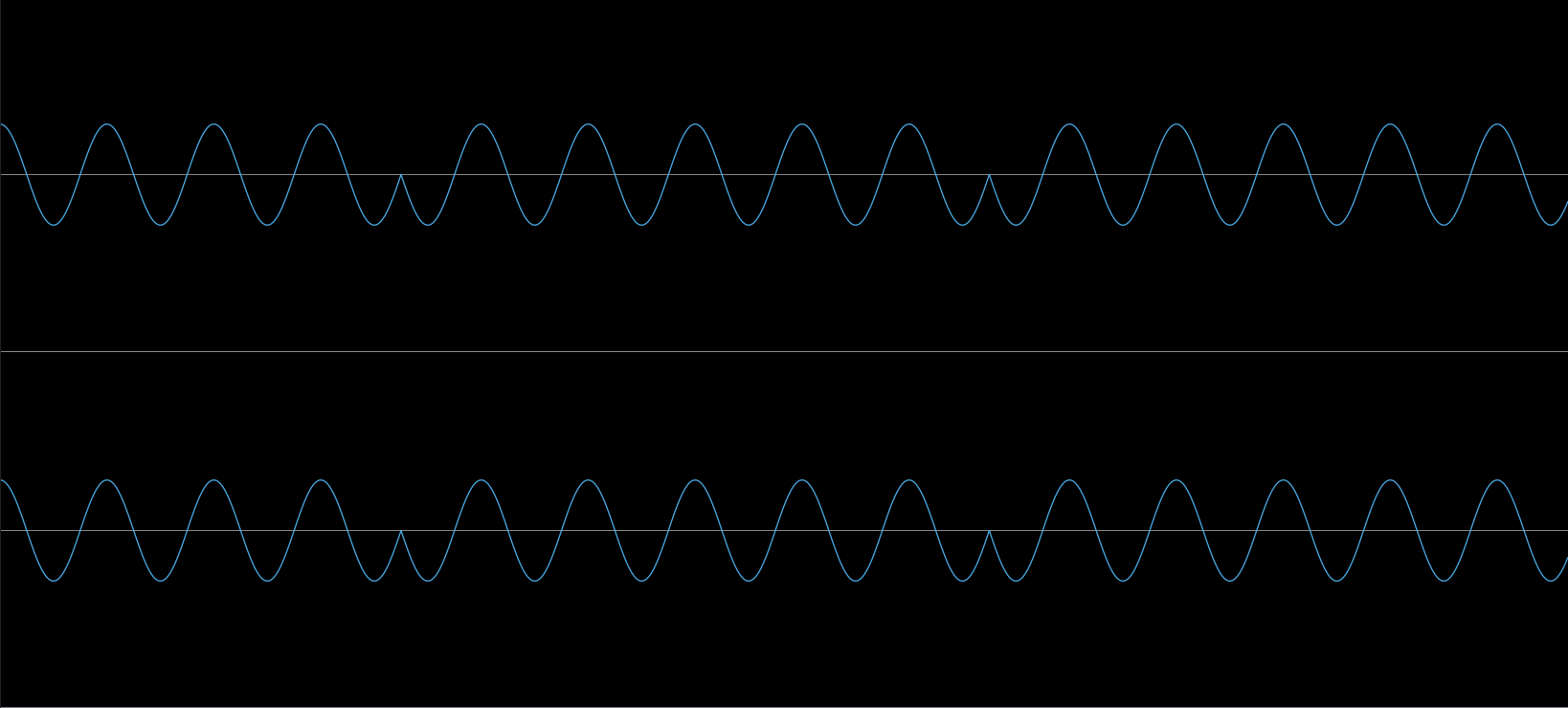
Not really sure what’s causing this and not sure either how to generate the oscillating amplitude properly so I can represent any frequency.
---
### Author:  [@Derek\_Burnheim](https://qa.fmod.com/u/Derek_Burnheim)
#### Post date: [June 4, 2019, 11:57pm UTC](https://qa.fmod.com/t/how-is-sound-generated-in-the-fmod-plugin-api/14725/4 "2019-06-04T23:57:44Z")
Okay, there’s a couple of issues I can spot there.
First, the samples generated by the generate function need to be interleaved into the output buffer. The interleaved buffer format groups samples by channels, so the first _n_ entries are the first sample for each of the _n_ channels, the second _n_ entries are the second sample for each of the channels, and so on. Another way to think of it is that the buffer is a sequence of _sample frames_ where each frame is a single sample for each channel. The length parameter of the DSP process callback is the number of sample frames.
This diagram shows how three frames of sample data for 5.1 surround would be interleaved:

fmod\_noise.cpp does have a comment mentioning this interleaving requirement, and the first loop which deals with gain ramping to avoid pops does explicitly interleave the output samples by iterating by samples then channels, but unfortunately it doesn’t demonstrate interleaving the generated signal for the main loop. Because it’s a noise generator it doesn’t bother to generate discrete signals for each channel.
It might be easier to understand if a generate function was evaluated for each channel. In your case to generate a sine wave:
```auto
for (unsigned int s = 0; s < length; ++s) // for each frame
{
for (unsigned int c = 0; c < channels; ++c) // for each channel
{
*outbuffer++ = sinf((2 * PI) * m_rotation);
}
m_rotation += m_frequency / sampleRate;
}
```
You might notice that I changed your evaluation code slightly there, introducing the variable m\_rotation which is incremented for each sample frame. This brings me to the second problem I can see with your current implementation - your generator needs to keep track of its position as it generates so that successive calls to your DSP process function will generate sequential sample frames instead of just generating the first _n_ sample frames each time it is called. After a frame is generated the rotation is incremented by the desired frequency of the sine wave (in degrees per second), divided by the system sample rate (in hertz). The system sample rate can be retrieved via the FMOD\_DSP\_STATE passed to the process callback:
```cpp
// Get the system sample rate. Error result handling ommitted for clarity.
float sampleRate;
dsp->functions->getsamplerate(dsp, &sampleRate);
```
I hope this answer gets you unstuck, but please don’t hesitate to ask for more help if anything is unclear, this will help guide us in improving the quality of our documentation!
---
### Author:  [@chrisjdarcy](https://qa.fmod.com/u/chrisjdarcy)
#### Post date: [June 5, 2019, 3:28pm UTC](https://qa.fmod.com/t/how-is-sound-generated-in-the-fmod-plugin-api/14725/5 "2019-06-05T15:28:44Z")
I’ve implemented everything that you mentioned but I’m still getting broken sine waves.
Should I be using the DSP API or the Plugin API? The documentation and what you’ve said gives me conflicting ideas that they’re the same thing and two different things.
The starting ramp didn’t seem necessary so I removed that part, didn’t seem to affect anything with the example I had running the code in the previous post. Seems to me that I’ll get more flexibility using an AHDSR.
The “getsamplerate” function can’t accept a int, so I changed it to that.
I’m getting errors that m\_frequency, m\_rotation and m\_samplerate and undeclared and undefined in the generate callback, should I be adding them to the arguments of the generate callback? For the meantime I’ve set m\_rotation declaration to 0 and frequency to 158400 degree per second (440Hz). I included the get sample rate segment in the dspprocess callback and edited the generate callback to include the sample rate as one of the arguments.
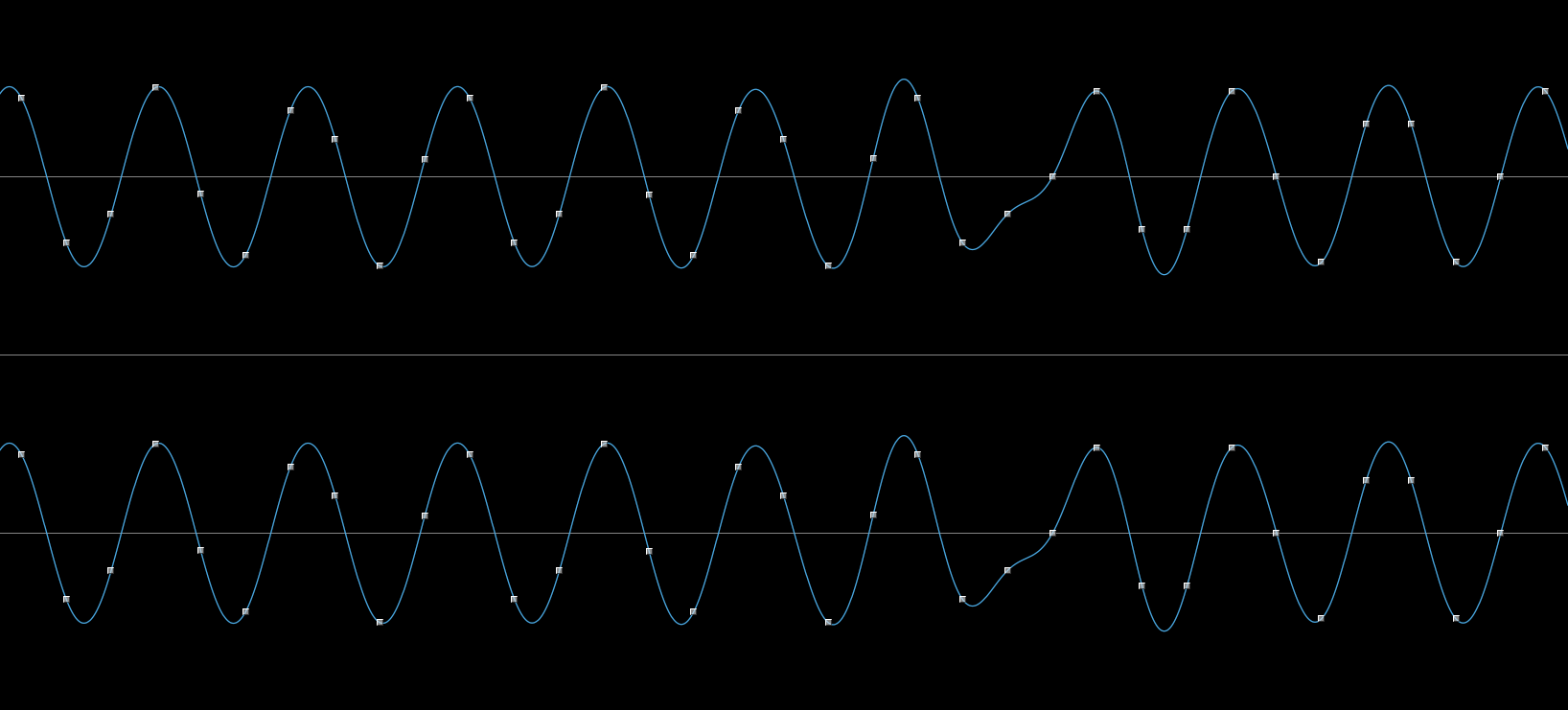
With this implementation I get this:
[ ](https://i.gyazo.com/2fbd954358c3a5db36f8008edbe4d8a8.png)
That signal is at ~14kHz for some reason.
The code changes are as below:
> void FMODNoiseState::generate(float \*outbuffer, unsigned int length, int channels, int samplerate)
> {
> float m\_rotation = 0.0f;
>
> ```
> // Note: buffers are interleaved
>
> ```
>
> for (unsigned int s = 0; s \< length; ++s) // for each frame
> {
> for (unsigned int c = 0; c \< channels; ++c) // for each channel
> {
> \*outbuffer++ = sinf((2 \* PI) \* m\_rotation);
> }
>
> ```
> m_rotation += 158400.f / samplerate;
> }
>
> ```
>
> }
> FMOD\_RESULT F\_CALLBACK FMOD\_Noise\_dspprocess(FMOD\_DSP\_STATE \*dsp, unsigned int length, const FMOD\_DSP\_BUFFER\_ARRAY \* /_inbufferarray_/, FMOD\_DSP\_BUFFER\_ARRAY \*outbufferarray, FMOD\_BOOL /_inputsidle_/, FMOD\_DSP\_PROCESS\_OPERATION op)
> {
> FMODNoiseState \*state = (FMODNoiseState \*)dsp-\>plugindata;
>
> ```
> if (op == FMOD_DSP_PROCESS_QUERY)
> {
> FMOD_SPEAKERMODE outmode = FMOD_SPEAKERMODE_DEFAULT;
> int outchannels = 0;
>
> switch(state->format())
> {
> case FMOD_NOISE_FORMAT_MONO:
> outmode = FMOD_SPEAKERMODE_MONO;
> outchannels = 1;
> break;
>
> case FMOD_NOISE_FORMAT_STEREO:
> outmode = FMOD_SPEAKERMODE_STEREO;
> outchannels = 2;
> break;
>
> case FMOD_NOISE_FORMAT_5POINT1:
> outmode = FMOD_SPEAKERMODE_5POINT1;
> outchannels = 6;
> }
>
> if (outbufferarray)
> {
> outbufferarray->speakermode = outmode;
> outbufferarray->buffernumchannels[0] = outchannels;
> }
>
> return FMOD_OK;
> }
> int sampleRate;
> dsp->functions->getsamplerate(dsp, &sampleRate);
> state->generate(outbufferarray->buffers[0], length, outbufferarray->buffernumchannels[0], sampleRate);
>
> return FMOD_OK;
> }
>
> ```
---
### Author:  [@Derek\_Burnheim](https://qa.fmod.com/u/Derek_Burnheim)
#### Post date: [June 6, 2019, 1:31am UTC](https://qa.fmod.com/t/how-is-sound-generated-in-the-fmod-plugin-api/14725/6 "2019-06-06T01:31:19Z")
Sorry Chris, I should have spelled out that m\_rotation needs to be added as a member variable to the DSP state (FMODNoiseState). It should be set to zero in the reset function. Resetting it to zero each time you call generate is what’s causing that discontinuity.
The higher than expected frequency is because you multiplied the frequency in Hz by 360 to convert to degrees per second but that conversion was already being done implicitly in the call to sinf. The result is that your output frequency will be 360 times the desired frequency (15.84kHz instead of 440Hz).
Regarding the API, our plugin API is composed of the DSP API, the Output API and the Codec API - the DSP API is absolutely the right choice here. (It should be feasible to build a generator using the Codec API but it’s definitely not recommended!)
---
### Author:  [@chrisjdarcy](https://qa.fmod.com/u/chrisjdarcy)
#### Post date: [June 6, 2019, 11:05am UTC](https://qa.fmod.com/t/how-is-sound-generated-in-the-fmod-plugin-api/14725/7 "2019-06-06T11:05:23Z")
Thanks Derek, for clearing that up. You can probably already tell that this is unexplored territory for me.
I’ve zeroed the m\_rotation variable in the reset function set it as a member variable in the FMODNoiseState class. I’ve tested m\_rotation in both public and private and I get the same result.
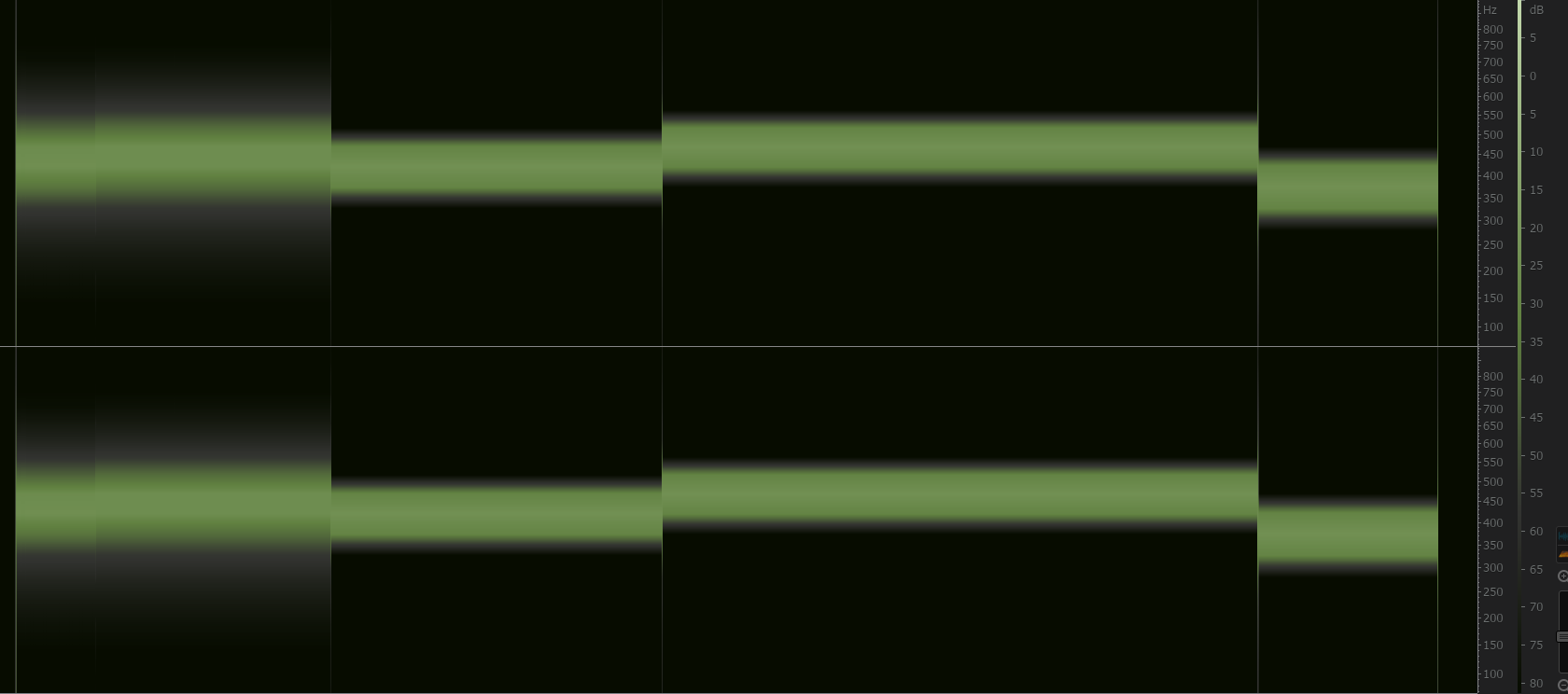
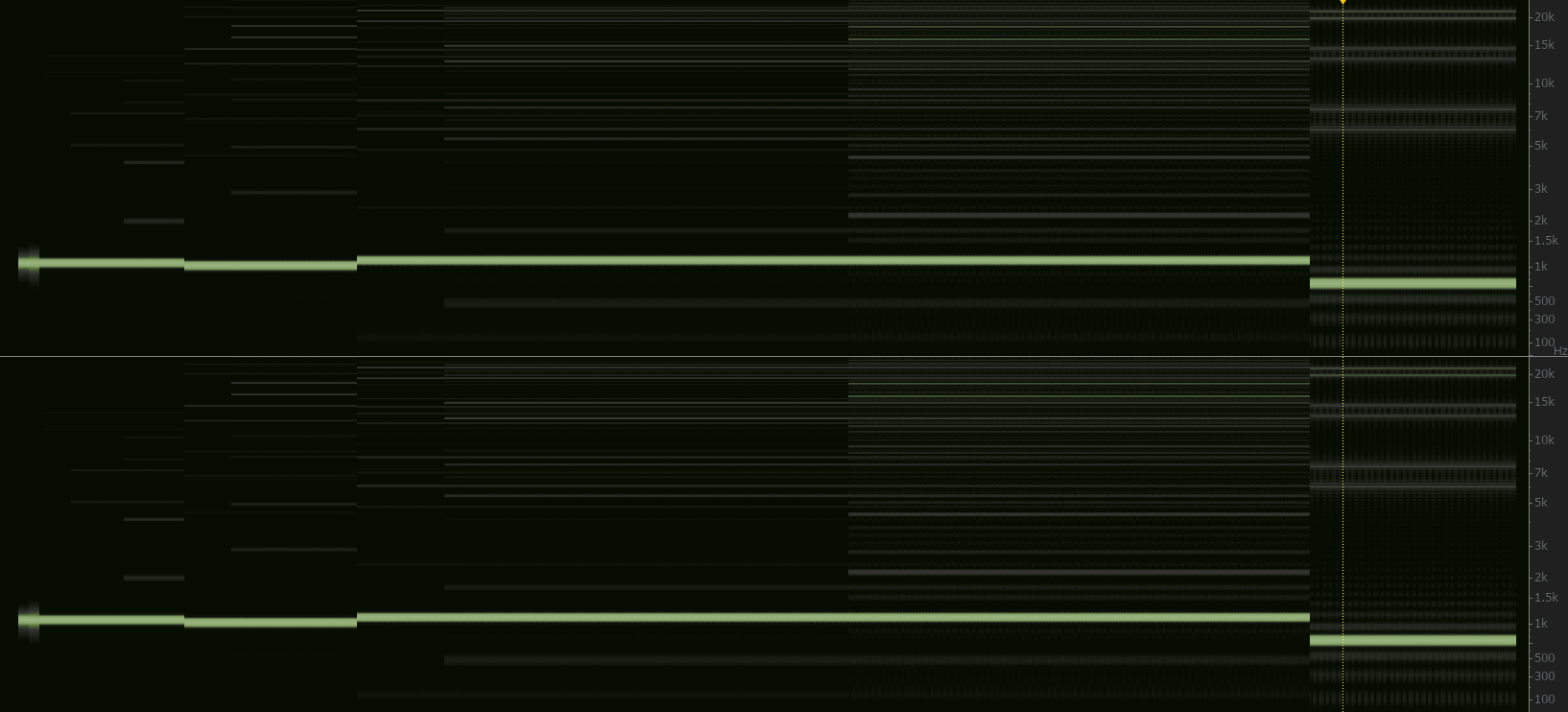
I’m getting a steady sine wave, no discontinuity. However, the frequency jumps to either side of the specified frequency after a while. This is repeatable and doesn’t change on subsequent playings, but does change depending on the frequency specified in code.
The first is set to 440Hz, the second set to 1075Hz
[ ](https://i.gyazo.com/81c5c0b81d6155084db65a688f3105e2.png)
[ ](https://i.gyazo.com/e9ddbd7d04b341ffc3eab1cea8df9d4d.png)
Pretty drastic drop at the end of this one.
You can also see the building of harmonics scattered all about.
Could these be results of cumulative floating point errors? I’ve been looking at other synthesis frameworks and they use doubles for buffer values and such. Would that help?
---
### Author:  [@Derek\_Burnheim](https://qa.fmod.com/u/Derek_Burnheim)
#### Post date: [June 7, 2019, 12:12am UTC](https://qa.fmod.com/t/how-is-sound-generated-in-the-fmod-plugin-api/14725/8 "2019-06-07T00:12:37Z")
Hi Chris
I don’t know what might cause that and I’m afraid it’s really beyond the scope of support we can offer on the forums. It may be a range/precision issue in which case keeping m\_rotation normalized in the +/- 180 degree range would fix it. Perhaps other forum users might have some insight into this phenomenon.
If you have further questions about using our API we’re always happy to help answer those!
Cheers
Derek
---
### Author:  [@chrisjdarcy](https://qa.fmod.com/u/chrisjdarcy)
#### Post date: [June 7, 2019, 1:03pm UTC](https://qa.fmod.com/t/how-is-sound-generated-in-the-fmod-plugin-api/14725/9 "2019-06-07T13:03:41Z")
Okay, I’ll keep looking. Is it possible to debug or profile the plugin dll when running in FMOD Studio?
---
### Author:  [@Derek\_Burnheim](https://qa.fmod.com/u/Derek_Burnheim)
#### Post date: [June 11, 2019, 1:30am UTC](https://qa.fmod.com/t/how-is-sound-generated-in-the-fmod-plugin-api/14725/10 "2019-06-11T01:30:57Z")
Yes, please consult the Visual Studio docs for the version of Visual Studio you’re using.
---
### Author:  [@chrisjdarcy](https://qa.fmod.com/u/chrisjdarcy)
#### Post date: [June 11, 2019, 10:44am UTC](https://qa.fmod.com/t/how-is-sound-generated-in-the-fmod-plugin-api/14725/11 "2019-06-11T10:44:57Z")
After looking it over with one of our programmers, the errors and drifting frequencies was caused by cumulative floating point errors.
As long as the maths before the outbuffer is done in doubles, these problems should be mitigated.
> double m\_Freq = 1175.0;
>
> for (unsigned int s = 0; s \< length; ++s) // for each frame
> {
> for (int c = 0; c \< channels; ++c) // for each channel
> {
> \*outbuffer++ = sin((2.0 \* PI) \* m\_rotation) \* (sin((2.0 \* PI) \* m\_LFO\_rot));
> }
>
> ```
> m_rotation += m_Freq / samplerate;
> m_LFO_rot += 3.0 / samplerate;
>
> ```
>
> }
---
### Author:  [@TheoMi](https://qa.fmod.com/u/TheoMi)
#### Post date: [June 23, 2019, 10:42am UTC](https://qa.fmod.com/t/how-is-sound-generated-in-the-fmod-plugin-api/14725/12 "2019-06-23T10:42:06Z")
For a periodic signal - x (t), it is true that x (t + T) = x (t), where T is a signal period. After m\_rotation exceeds unity , the signal will repeat,
so you can and should limit the range of m\_rotation.
if (m\_rotation\> = 1) m\_rotation- = 1